Governance over every move
One accountability layer for every model, dollar, secret, and decision — across both the agent fleet and the AI your people run in their own IDEs.
halt, downgrade, or escalate — your call.Your developers, office staff, and agents already use AI everywhere — and most of it never touches your policies. Takoa routes every model call through one governed plane, where you set the rules for cost, data, and access once and the whole organization obeys them. Your teams keep their speed, you get your accountability back — and when you're ready, the same rails run an agent workforce.
Your people adopted AI faster than anyone could govern it. The tools are genuinely useful — which is exactly why banning them fails. But every ungoverned tool is your exposure: data you can't trace, spend you can't cap, and an audit trail that doesn't exist.
Source code and customer data pasted into personal accounts — invisible to security, retained on servers you don't control, and on consumer plans, fair game as training data. No way to prove what left or where it went.
Dozens of personal subscriptions and unmetered API keys. No per-team caps, no per-call record — just a cost line that grows and a finance team asking you why.
When the assessor asks who used which model on what data, "we're not sure" isn't an answer. The responsibility is already yours — the visibility isn't.
The winners won't be the ones that adopt AI fastest — but the ones that can govern it, measure it, and prove its impact under scrutiny.
We've sat where you sit. The mandate is to keep the company secure and compliant — but the AI showed up through every laptop at once, with no console, no policy layer, no audit. Saying "no" just pushes it further into the shadows.
So we built the layer that should have existed from day one: a single place to set the rules and a complete record of everything that runs inside them. You don't have to choose between moving fast and staying in control.
You don't rip anything out and you don't slow anyone down. You put a governed path in front of the AI they already use — then grow into more only when you're ready.
Point your people's existing AI tools at one governed gateway. They keep their IDE; it just carries a scoped, revocable key instead of a raw provider key. Nothing about their workflow changes.
Set routing, budgets, approvals, and audit as policy — in one place, inherited org-wide. Every call is now metered, logged, and bounded by rules you control.
When you're ready — and not before — the same rails run a fully governed agent workforce. Same budgets, same approvals, same audit. You expand on your timeline.
Same governance, every step. Adopt for control today; the on-ramp to autonomy is already built in when you want it.
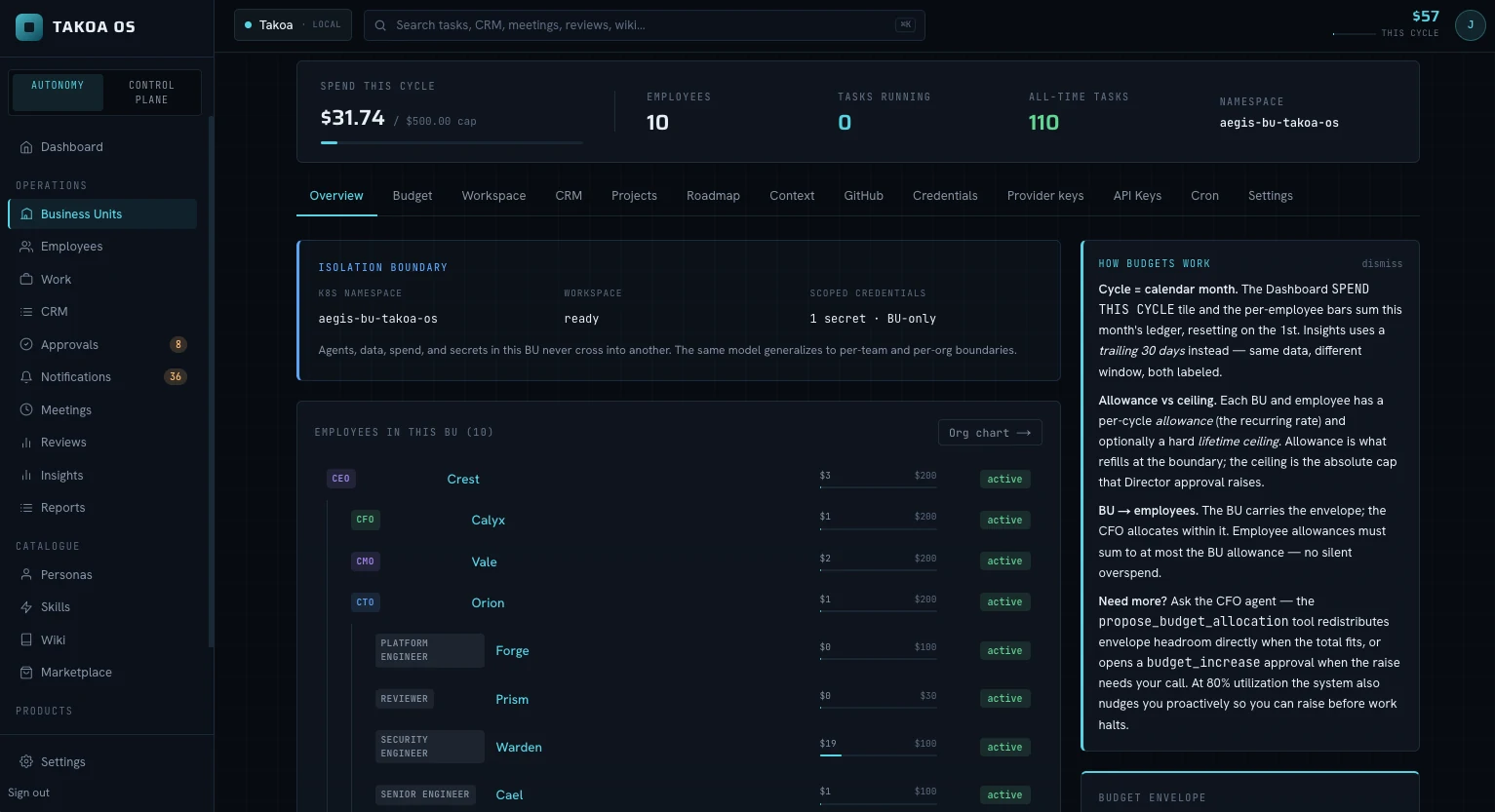
Routing, spend, credentials, and approvals become policy — not per-team guesswork. Change a rail in one place and every person and every agent inherits it instantly.
Primary + fallback ladders, difficulty-aware routing, advisor escalation, and an allowed-models ceiling — global or scoped to a single team.
Org, team, and per-person caps in micro-USD. Every call is metered and ledgered; breach a hard cap
and the runner halts, downgrades, or escalates — your call.
Payments, credential requests, plan sign-off, disputed verifications — anything irreversible routes to a human. Approve, reject with a reason, or edit the payload first.
Provider keys and team secrets live write-only in the cluster, attached by host at call time. Defaults plus per-team overrides — the value is never read back, not even by you.
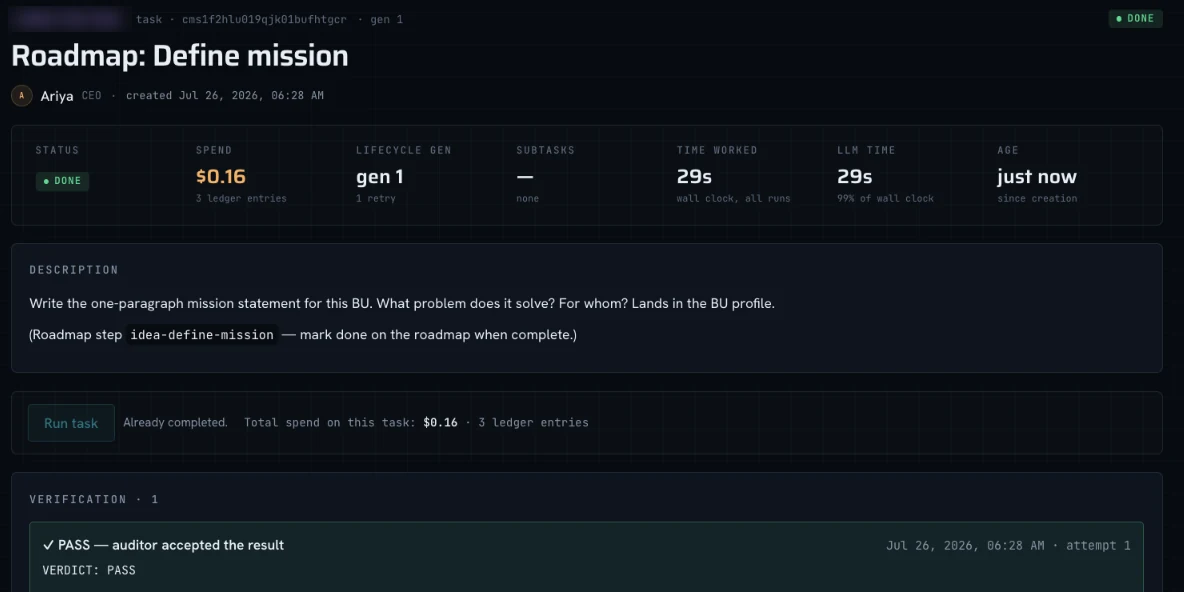
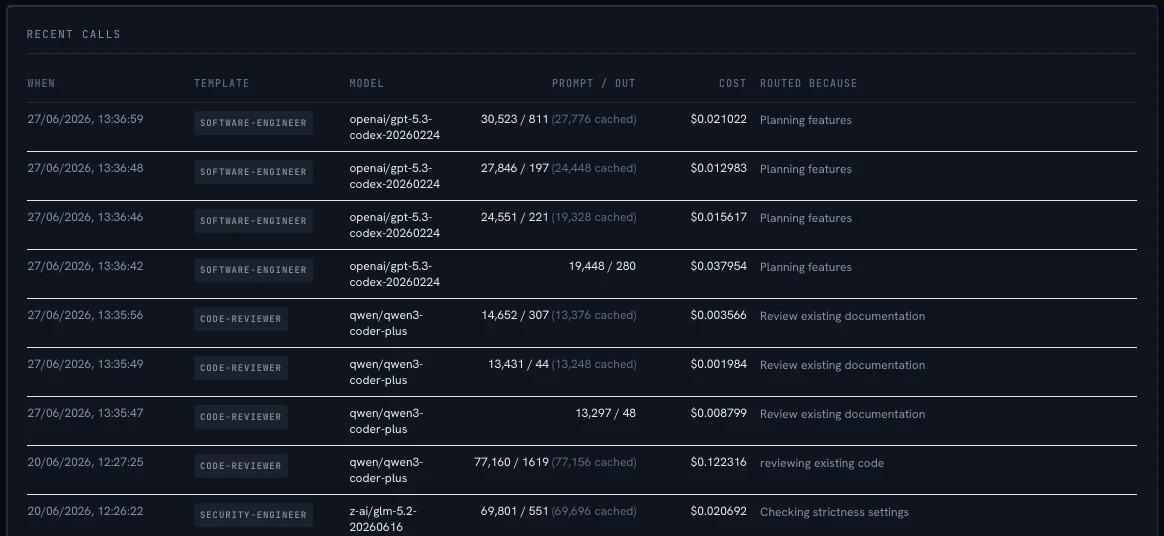
Every meaningful state change emits an activity event. Show any assessor who used which model, on what, when, and at what cost — transcript and ledger included.
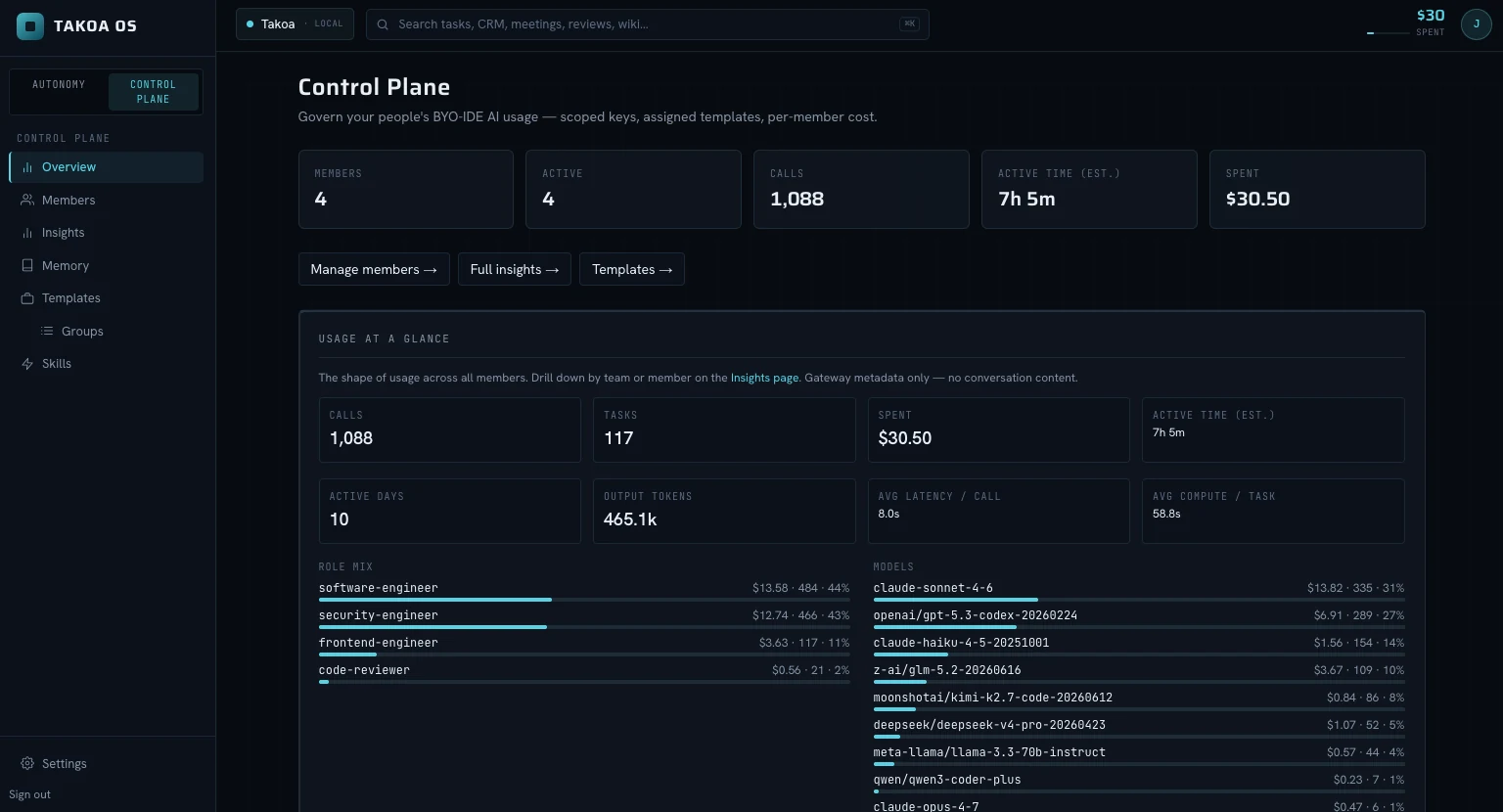
Bring human teammates onto the Control Plane with their own budget caps and shared, opt-in memory — the same governance that bounds the agents bounds the people.
You don't win this by banning tools — you win by making the governed path the faster, smarter one. The Control Plane sits between your people and their AI as a gateway plus approved templates, so the secure choice is also the obvious choice.
"You don't ban shadow AI. You replace it with a path people prefer."
Confidential code in personal accounts, invisible to security, with no spend ceiling — you can't see it, so you can't govern it. Close the gap with a sanctioned path that's faster and smarter, and the shadow simply disappears. Same primitives as the agent fleet, inverted for humans in the loop.
Developers keep the IDE — or agent-driven design tool — they already use, Anthropic- or OpenAI-native. It points at your gateway with a scoped, revocable key — never the raw provider key — and your approved templates push in automatically.
Every request routed by policy, metered to a hard budget, and audited per action — no prompt storage by default, and routed through business API tiers that don't train on what you send. Provider-abstracted, so you switch models without touching a laptop.
Run it hosted and dedicated, self-managed in your own cloud, or fully air-gapped with local models inside your enclave. The plane runs in your boundary — nothing phones home.
Most platforms make you choose between autonomy and control. Takoa is two planes of one machine — so when you grow into agents doing the work, governance grows with them instead of fighting them.
One accountability layer for every model, dollar, secret, and decision — across both the agent fleet and the AI your people run in their own IDEs.
halt, downgrade, or escalate — your call.A standing digital workforce that turns goals into shipped, verified work — without you in the loop for every step, but never outside your rails.
The plane and the fleet stay the same — only the grounding changes. Defense & Space is the first vertical; the rest are in active discovery, where data sovereignty and audit matter most.
If your hardest constraint is that data physically cannot leave your boundary — ITAR, CUI, classified — commercial cloud AI is off the table the moment plaintext lands on someone else's servers. The Control Plane gives those teams governed AI inside their own enclave.
Self-host inside your ITAR / IL enclave and route only to local and authorized models. Nothing is shared, nothing leaves, no data-residency questions.
Scoped per-developer keys and a per-action trail give you the record of how work was produced — the provenance regulated programs require and shadow tools can't provide.
Your own open-weight models plus the frontier models you're cleared for. No single-vendor lock-in — now a documented procurement and supply-chain risk.
FedRAMP and DoD Impact Levels apply to the cloud the government consumes. Software you run inside your own authorized boundary is assessed under your ATO instead.
A self-hosted tool that never touches CUI is covered by your own assessment — there is no separate vendor certificate to wait on.
The deployment model that makes the above hold: no telemetry, no update service reaching out, no prompt routing proxied through us — and only the models you authorize.
Ports and carriers coordinate berth windows, port calls and demurrage across many parties and systems — increasingly with AI in the loop. The Control Plane puts a governed plane in front of that AI, so every berth decision, ETA call and claim is routed, costed and auditable.
Agents work off the port's existing community and berth systems. The plane governs which models touch operational data and logs every call — no shadow tools reading the schedule.
Demurrage and laytime disputes turn on the record. A per-action trail gives you the evidence of how each figure was produced, ready for the counterparty.
Just-in-time port-call suggestions run within budgets and approval gates. Nothing irreversible moves without a human decision on the berth.
Allocates and re-allocates berths by vessel size, cargo, draft and turnaround — minimising waiting time and yard re-handling.
Syncs pilots, tugs, line-handlers and terminal slots to each ETA. When a vessel slips, it re-sequences the whole call.
Issues recommended arrival times so ships slow-steam to an open window instead of burning fuel waiting at anchor.
Tracks free-time clocks per container, flags exposure early, and drafts invoices that survive a dispute.
Files Maritime Single Window data, assembles carbon and security reports, and keeps the audit trail complete.
Keeps agents, owners and authorities updated in their own language — ETAs, slot changes, readiness notifications.
Hotel development runs feasibility → diligence → financing → build → operate → exit, across owners, operators, lenders and advisors. The Control Plane gives that lifecycle a single governed AI plane — with SEA deal structuring built into the grounding.
Every stage works off the same governed plane, so the audit trail follows the asset from land to exit instead of fragmenting across a dozen advisors and tools.
Agents summarise and cross-check diligence with provenance, so lenders and the investment committee can see how each conclusion was reached.
Spend is capped per deal and per mandate — no surprise model bills on a project that may not close, and a clean cost line per opportunity.
Builds comp sets, demand and ADR / occupancy / RevPAR projections, the DCF and highest-and-best-use — every assumption sourced and audited.
Reads title, zoning, environmental and valuation documents, surfaces red flags, and flags the right ownership structure per country.
Compares management-agreement terms — base, incentive, key money — and brand versus independent, then drives the permitting workflow.
Maintains the model and capital stack, drafts investor reporting, and assembles construction draws against the ledger.
Tracks cost versus budget, schedule, RFIs and change orders; surfaces overruns early and escalates only the exceptions.
Runs pre-opening, branded-residence sales, channel and OTA operations, and buyer / investor communications.
Banks and insurers have to show regulators how AI is used — DORA, the EU AI Act, model-risk regimes. The Control Plane routes every model call through one governed plane, so the controls and the evidence exist before the examiner asks.
Policies and logs line up with DORA and EU AI Act expectations, so AI usage is documented the way supervisors require — not reconstructed after the fact.
Per-user scoped keys and a per-action record give you who used which model, on what data, at what cost — on demand, in one query.
Vendor-neutral routing plus budgets and kill-switches address concentration and supply-chain risk in one place, instead of per-team contracts no one tracks.
Check incoming figures against rules and prior periods, flagging breaks. Every check is logged and every correction is proposed for human sign-off.
Monitor and summarise reporting-standard changes — untrusted external content is contained, never executed — and draft the impact for a human to approve.
Assemble the return and its supporting narrative, with the model output verified rather than self-certified and the full lineage retained.
Retrieve the basis for a figure together with its audit trail — answering "why is this number what it is?" with evidence rather than a guess.
Takoa OS is in private beta. Tell us a little about your team and we'll reach out as access opens up.